Project tracker

Improvements

Track walking and biking improvements that are already built, underway, funded, or officially proposed by Walnut Creek, CCTA, BART, or other public agencies. This page explains what each improvement changes, where it is, what stage it is in, and why it matters for safer, more useful walking and biking around Walnut Creek. These are meaningful public investments in everyday safety and mobility, and we are grateful to the City of Walnut Creek and its partner agencies for moving long-awaited improvements from plans into the streets, trails, and crossings residents use every day.

Completed#

Improvements that are built and available for people walking or biking.

Trinity Avenue and Oakland Boulevard Bike Improvements#

Completed

Location
Trinity Avenue and Oakland Boulevard, connecting Walnut Creek BART and downtown

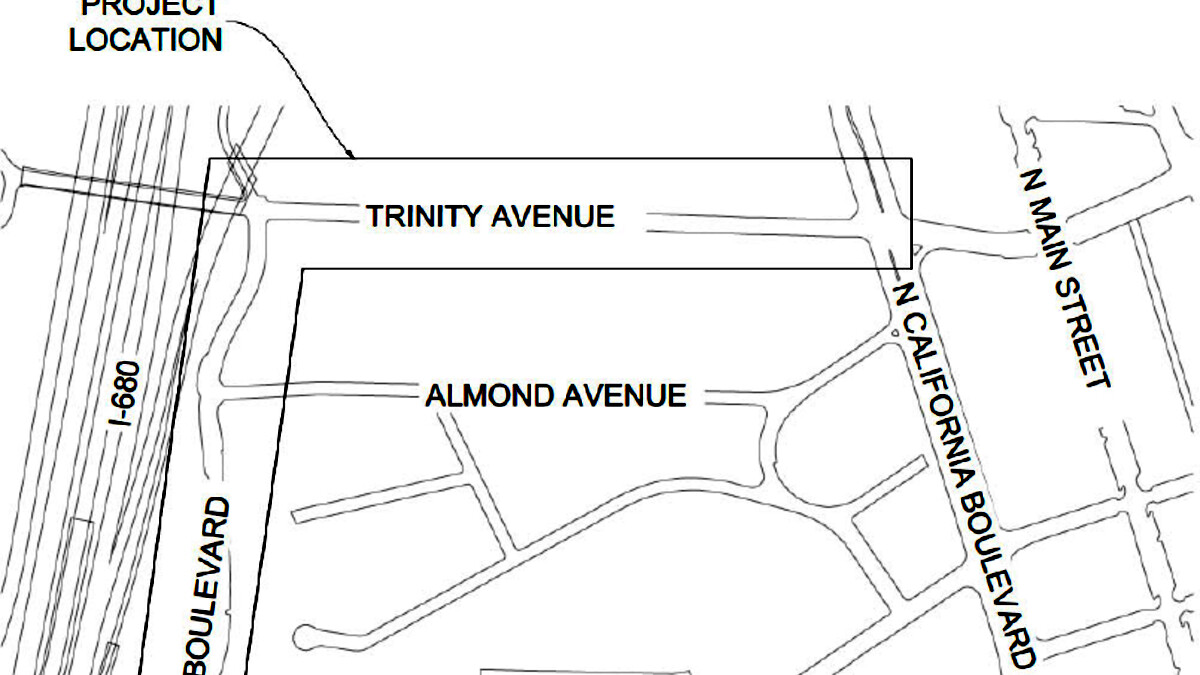
The city added a westbound painted bike lane and eastbound shared-lane markings on Trinity Avenue, along with a two-way bikeway beside Oakland Boulevard. We are grateful to the City for completing this useful connection between Walnut Creek BART, downtown, and neighborhoods west of downtown.

These changes give people biking a clearer route between the station and downtown. It is not the straightest BART-to-downtown path, but it creates a real option and helps fill in one piece of the larger bike network.

The same connection also helps people west of downtown ride into downtown with fewer gaps. We love seeing this kind of practical connection show up on the ground.

Project location map showing Trinity Avenue and Oakland Boulevard near Walnut Creek BART and downtown.
City project location map. Source

Trail Crossing Improvements#

Completed

Location
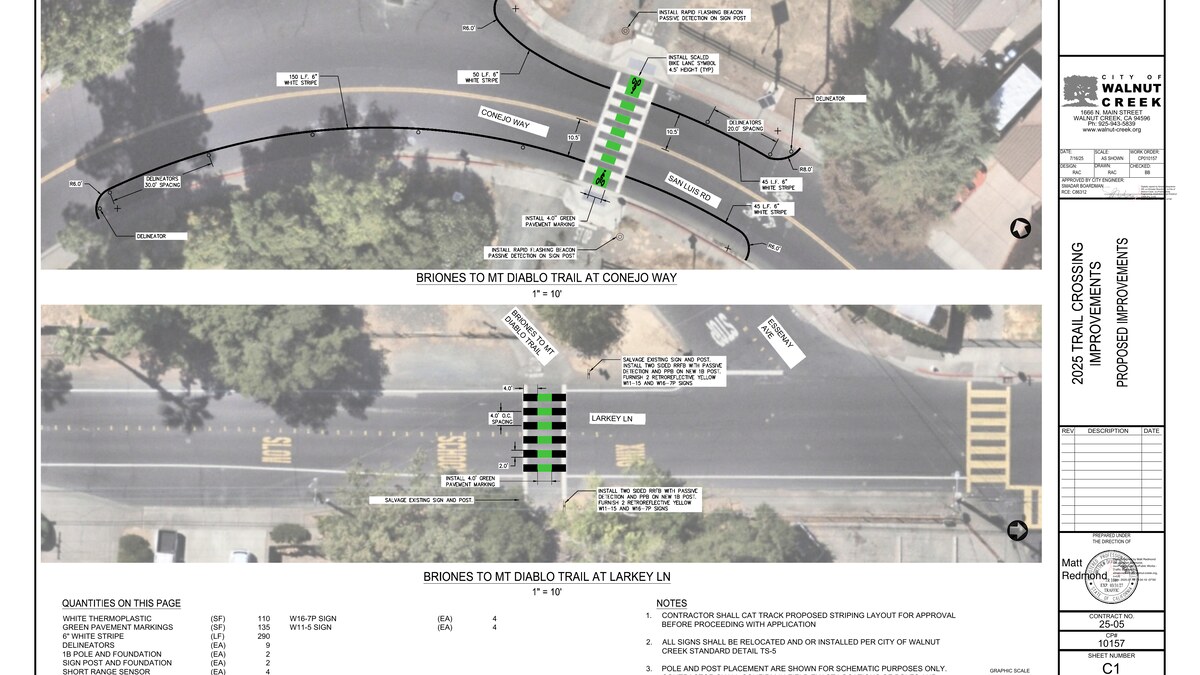
Civic Drive, Oak Road, Geary Road, Mt. Diablo Boulevard, Tice Valley Boulevard, and Bancroft Road crossings

The city has completed a new set of trail and crossing safety improvements around Walnut Creek. We are grateful for these practical upgrades at the places where people walking and biking meet busy streets.

The completed crossings currently listed are:

  • Civic Drive and Carlback Avenue
  • Civic Drive and Arroyo Way
  • Oak Road and Kingston Avenue
  • Civic Drive and Deodora Way
  • Geary Road and Vessing Road
  • Mt. Diablo Boulevard and Bont Lane
  • Three crossings on Tice Valley Boulevard
  • Bancroft Road and Stratton Road
  • Bancroft Road and Gill Port Lane

Additional trail-crossing upgrades will need another budget cycle to determine the next planned locations.

Map showing completed trail crossing improvement locations in Walnut Creek.
Completed trail crossing improvement locations.

Lennon Lane Protected Bike Lanes#

Completed

Location
Lennon Lane

The city repaved Lennon Lane and added one-way separated bikeways, making this Shadelands street an early protected-bike-lane project in Walnut Creek.

The Lennon Lane project turned repaving work into a low-stress biking improvement. The protected bike lanes give people biking dedicated space separated from moving traffic by striping and posts.

This work also helped set up later Shadelands roadway improvements on Wiget Lane and Shadelands Drive.

North Wiget Lane Protected Bike Lanes#

Completed

Location
North Wiget Lane from Ygnacio Valley Road to Lennon Lane

The city completed roadway improvements on North Wiget Lane, including repaving, protected bike lanes, new on-street parking, and access upgrades near the Contra Costa Canal.

The Wiget Lane project created dedicated protected bike lanes with posts separating the bike lanes from vehicle lanes. It also improved the Contra Costa Canal entrance with a crosswalk, curb ramp, and concrete path.

These changes make Shadelands easier to navigate for people walking and biking, not just for drivers.

South Main Street at Lilac Drive Pedestrian Scramble#

Completed

Location
South Main Street and Lilac Drive

The city added a pedestrian scramble phase at South Main Street and Lilac Drive, allowing students and other people walking to cross in all directions during the walk signal.

The Lilac Drive scramble was part of a package of South Main Street improvements that also included a refreshed roadway between Newell Avenue and Creekside Drive, a new midblock crossing at Kaiser, and concrete and striping improvements.

Scramble phases can reduce conflicts with turning vehicles and make a busy crossing easier to understand for people walking.

Locust Street Rehabilitation and Streetscape Improvements#

Completed

Location
Locust Street between Civic Drive and Mt. Diablo Boulevard

The city completed Locust Street rehabilitation and streetscape work, including pedestrian bulb-outs, ADA improvements, sidewalk repair, green infrastructure, and repaving.

The project added pedestrian bulb-outs at the Cypress and Bonanza Street intersections on Locust Street, improving visibility and shortening crossing distances in the heart of downtown.

It also repaired damaged sidewalks, replaced declining street trees, refreshed planter areas, added green infrastructure, and repaved Locust Street between Civic Drive and Mt. Diablo Boulevard.

Active#

Projects that are funded, designed, awarded, or moving through an official project process.

Newell Avenue Corridor Improvements#

Near-term phase funded and in design; construction likely in 2028

Location
Newell Avenue and the Newell Avenue / South Broadway / Iron Horse Trail intersection

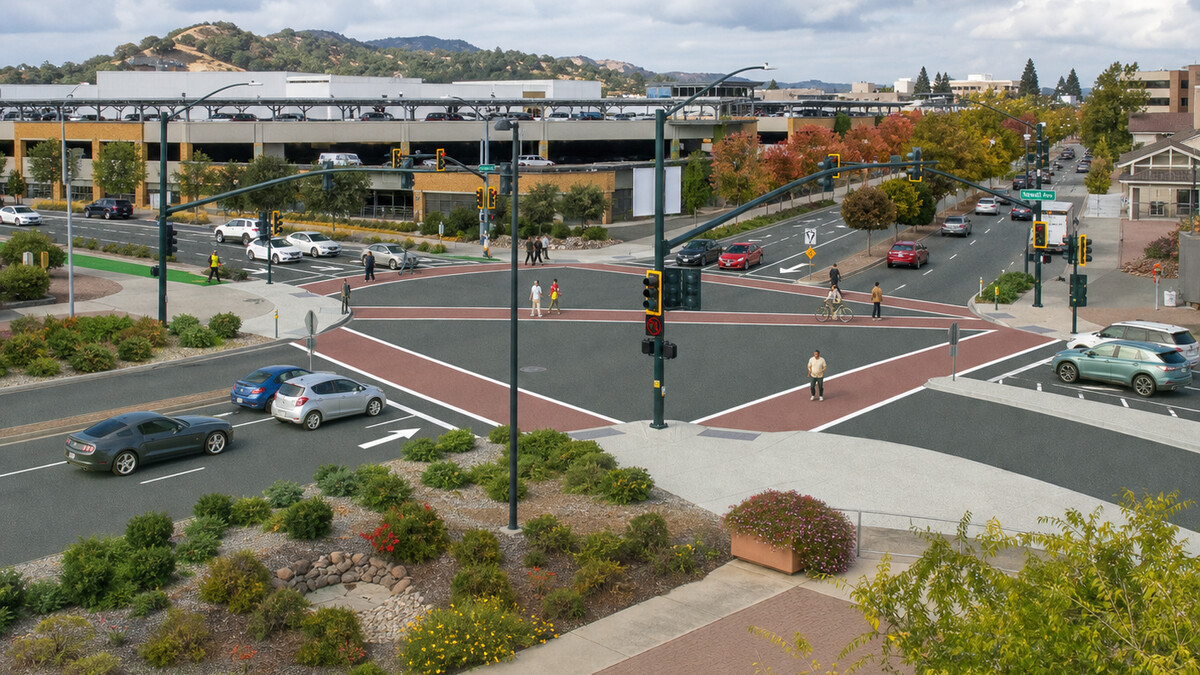
The city is redesigning Newell Avenue so people can walk and bike more safely between Las Lomas High School, Kaiser, South Broadway, the Iron Horse Trail, and nearby neighborhoods. This is a long-awaited improvement, and we are grateful the City is moving it forward.

The near-term project creates a diagonal scramble crossing at Newell and South Broadway. That lets people on the Iron Horse Trail cross the intersection more directly, instead of crossing two wide roads in separate steps.

The project is currently in design. Based on the latest city update, construction in 2028 is a safer planning assumption.

The project also adds raised or buffered bike lanes near the intersection, narrows parts of the roadway, removes or redesigns high-conflict turns, and creates more space for students walking and biking near Las Lomas High School. The funded project also includes street-level protected bike lanes in the eastbound direction from California Boulevard to Broadway.

The longer-term unfunded build-out continues the east-west bike connection on Newell and adds a mid-block crossing between Kaiser and destinations on the north side of the street. The city is identifying future funding opportunities, including grants, to build this portion of the project.

For students, Kaiser patients and employees, trail users, and nearby residents, this is the kind of project that can turn an awkward, high-stress crossing into a place that feels intentionally designed for people.

Read Walk Bike Walnut Creek's support letter

August 10, 2026

Tim Haile
Executive Director
Contra Costa Transportation Authority
2999 Oak Road, Suite 100
Walnut Creek, CA 94597

Subject: Letter of Support for Newell Avenue Bikeway Improvements

Dear Mr. Haile:

Walk Bike Walnut Creek strongly supports the City of Walnut Creek's application for funding for the Newell Avenue Bikeway Improvement Project between Maria Lane and California Boulevard.

Newell Avenue is one of the major arterial roads surrounding Downtown Walnut Creek and today acts as a significant barrier between downtown and the neighborhoods, schools, businesses, and medical facilities immediately to the south and east. For people walking and bicycling, reaching destinations such as the Iron Horse Trail, Whole Foods, Trader Joe's, Kaiser, and the rest of downtown can require stressful and circuitous crossings of a wide, busy roadway.

The existing bicycle facilities on Newell are inadequate for such an important connection. Replacing shared-lane facilities with Class IV protected bikeways, together with the improved Broadway/Newell crossing, shorter crossing distances, and new mid-block crosswalk, would make this corridor dramatically safer and more comfortable for people walking and biking.

The project also closes an important gap in the larger Olympic Corridor Trail connection and improves access to the regionally significant Iron Horse Trail, strengthening a broader network connecting neighborhoods, schools, employment, downtown destinations, and regional trails.

In my view, this is the most significant and exciting walking and biking improvement proposed for Downtown Walnut Creek that I have seen. It directly addresses one of the most difficult barriers around downtown and has the potential to transform how people reach the area on foot and by bicycle.

Walk Bike Walnut Creek strongly urges CCTA to fund the Newell Avenue Bikeway Improvement Project.

Thank you for your consideration.
Sincerely,

Toni Melisma
Walk Bike Walnut Creek

Concept rendering of the redesigned Newell Avenue, South Broadway, and Iron Horse Trail crossing with a diagonal scramble crossing.
Newell Avenue concept rendering from city outreach materials. Source

Safe Routes to School Infrastructure Improvements#

Fully funded; Cedro/Ebano curb-ramp work in design

Location
Multiple school-area locations in Walnut Creek

The city is improving school-area sidewalks and crossings so more students and families can walk safely near school. We are grateful for this direct investment in kids' everyday safety.

This package adds sidewalks and crossing improvements near schools in Walnut Creek. The goal is simple: fewer places where kids have to walk in the street, cross without enough visibility, or depend on a car for short school trips.

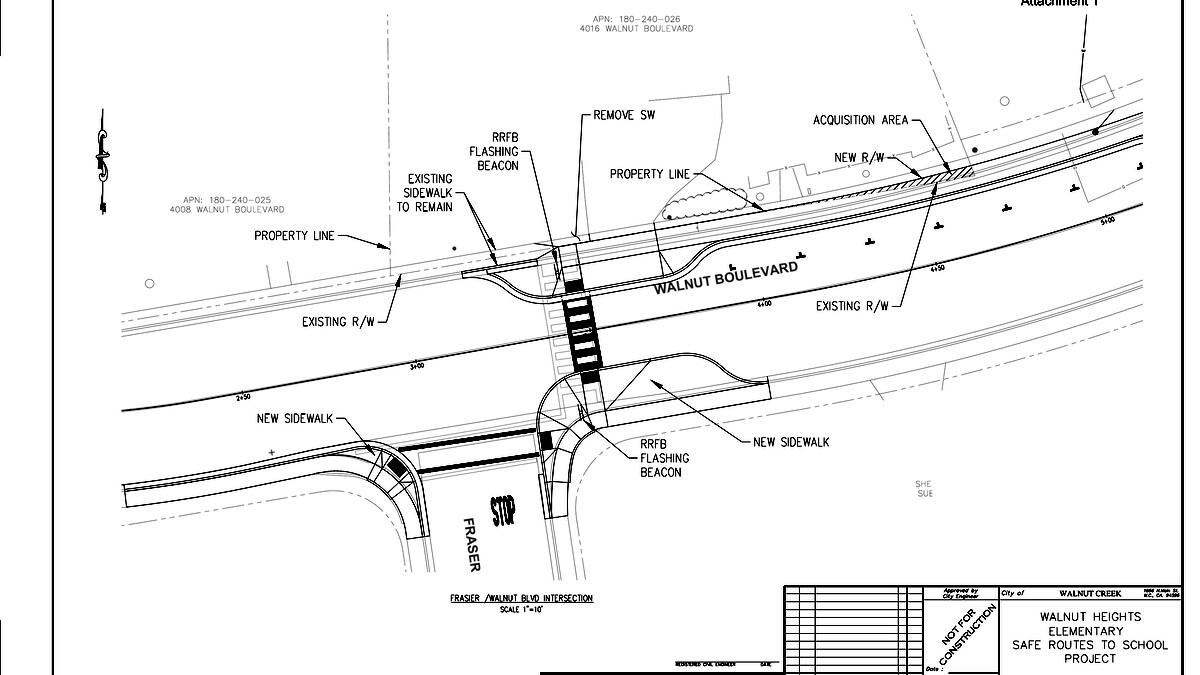
The funded package includes four projects and locations: sidewalks for Walnut Boulevard at Walnut Heights Elementary, a diagonal crossing for Broadway and Newell Avenue at the Iron Horse Trail near Las Lomas High School, curb extensions at Cedro Lane and Ebano Drive near Foothill Middle School and Walnut Acres Elementary, and sidewalk on Parkside Drive near Buena Vista Elementary.

Cedro Lane and Ebano Drive curb-ramp modifications are currently in design, with construction most likely in 2028.

These are not flashy projects, but they are deeply valuable. A completed sidewalk or safer school crossing can change a family's daily routine for years.

Plan drawing for Walnut Heights Elementary Safe Routes to School improvements at Fraser and Walnut Boulevard.
Walnut Heights Safe Routes to School project exhibit. Source

Middle Ygnacio Intersection Improvements#

Funded; programmed in FY26-FY27

Location
Ygnacio Valley Road at Walnut Boulevard, Wimbledon Road, Wiget Lane, Via Monte, La Casa Via / Kinross Drive, Marchbanks Drive / Tampico, and San Carlos Drive; Marchbanks Drive and Kinross Drive

The city has funded multiple signal and intersection improvements in the Middle Ygnacio area, including protected left-turn phasing and a Marchbanks/Kinross neighborhood traffic circle.

This is really two related efforts. The Highway Safety Improvement Program project adds protected left-turn phasing at Ygnacio Valley Road with Walnut Boulevard, Wimbledon Road, Wiget Lane, and Via Monte.

Additional traffic mitigation tied to The Glen funds signal and intersection improvements around Ygnacio Valley Road at Marchbanks Drive / Tampico, Kinross Drive / La Casa Via, and San Carlos Drive. The Marchbanks Drive and Kinross Drive treatment is expected to add a neighborhood traffic circle.

These are targeted intersection projects, but they matter because Ygnacio Valley Road is one of Walnut Creek's most important safety corridors and school-access routes.

Mitchell and Shadelands Drive Community Benefit Improvements#

Approved with Mitchell Townhomes project

Location
Mitchell Drive, Shadelands Drive, and Shadelands Drive / Via Monte

The Mitchell Townhomes project includes off-site mobility benefits: Class IV bikeways along parts of Mitchell Drive and Shadelands Drive and a single-lane roundabout at Shadelands Drive and Via Monte.

The community-benefit package extends Class IV bicycle facilities beyond the project frontage using striping, signage, and vertical separation posts. The roundabout at Shadelands Drive and Via Monte is intended to calm traffic and improve multimodal circulation in the Shadelands area.

This is the kind of development-related infrastructure that can help a new housing project knit into the surrounding walking and biking network.

North Broadway Road Diet#

Planned; construction expected to begin summer 2027

Location
North Broadway from Central Road to Civic Drive

The city is turning North Broadway into a calmer complete street with better sidewalks, safer crossings, and separated bike lanes. We are grateful to see this long-awaited North Downtown project advancing.

The project narrows the roadway, adds a one-way separated bikeway, widens sidewalks, shortens crossings, adds bulb-outs and lighting, and makes the corridor easier to use without a car.

This is an important North Downtown connection. It will help people reach housing, jobs, BART, the Iron Horse Trail, and downtown destinations more comfortably.

North Broadway has needed a calmer, more people-focused design for a long time. This project is exactly the kind of street investment that makes new housing and downtown access work better for residents.

Arroyo Way Improvements#

Planned with the North Downtown transportation package

Location
Arroyo Way between the Iron Horse Trail, Civic Drive, North Broadway, and Main Street

The city is improving Arroyo Way as a bike and walking connection between the Iron Horse Trail, Civic Drive, North Broadway, and the Main Street area. We are grateful the City is treating this small street as an important connection, not an afterthought.

The project adds bike lanes on part of Arroyo Way and a calmer bike-boulevard treatment near the Iron Horse Trail. It also improves crossings, narrows the street, adds lighting, and shortens crossing distances with bulb-outs.

This makes Arroyo more useful as a low-stress route into North Downtown instead of just another car-focused side street.

We love projects like this because they make the network feel more continuous. A calmer Arroyo Way helps people leave the trail and actually reach the places they are trying to go.

Parkside Drive Improvements#

Planned with the North Downtown transportation package

Location
Parkside Drive

The city plans to add separated bike lanes on Parkside Drive, giving people a more comfortable route north of Ygnacio Valley Road. We are grateful this corridor is part of the City's planned North Downtown improvements.

Parkside is one of the key pieces in the North Downtown bike network. A separated bikeway here would make everyday biking feel less exposed and help connect nearby housing, shops, offices, and routes toward BART and downtown.

For residents who already make short trips in this area, or would if the route felt safer, a separated bikeway can be the difference between a stressful ride and a normal errand.

Walden Road Bicycle Boulevard#

Planned with the North Downtown transportation package

Location
Walden Road

The city plans to make Walden Road a calmer bicycle boulevard so it works better as a neighborhood bike connection. We are grateful the City is including neighborhood-scale bike improvements in the larger package.

A bicycle boulevard uses a slower, lower-stress street to connect people biking through the area. On Walden, that helps tie together the North Downtown bike network and gives riders an alternative to busier roads.

This kind of quiet-street connection is easy to underestimate, but it can make biking feel more welcoming for people who do not want every trip to be on a major arterial.

Treat Boulevard Corridor Improvements#

County-led project; construction likely in 2027 or 2028

Location
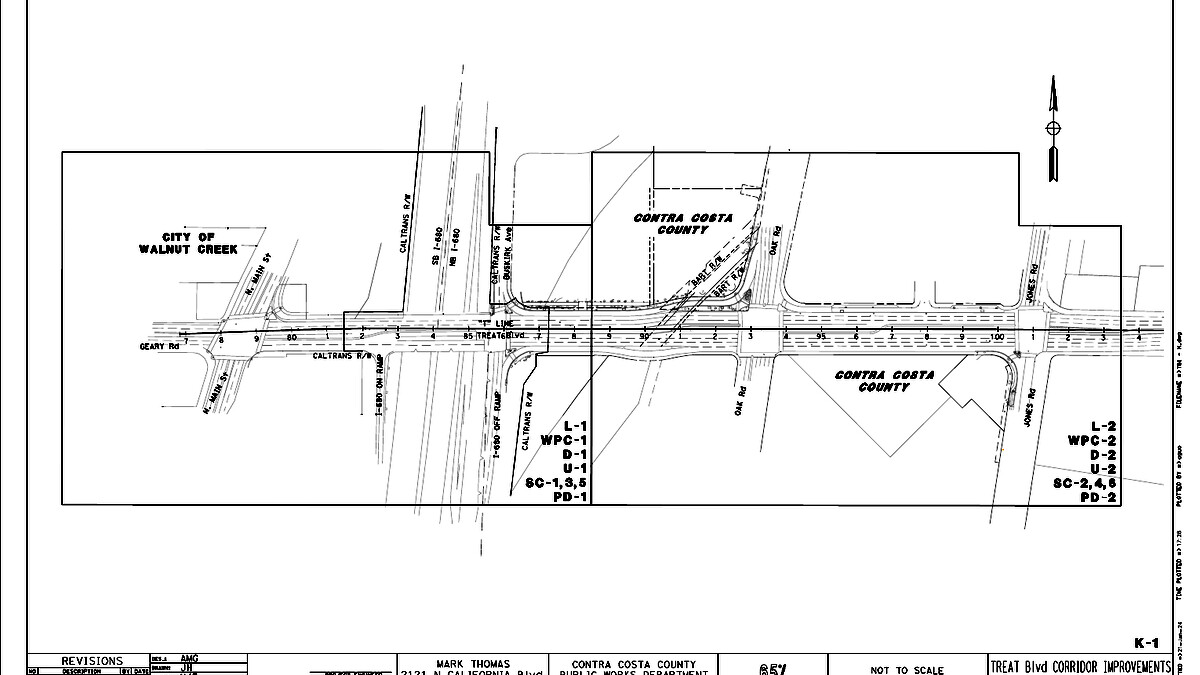
Treat Boulevard between North Main Street and Jones Road

Contra Costa County and Walnut Creek are improving Treat Boulevard with protected bike facilities, safer crossings, and signal upgrades. We are grateful for the City's participation in this important county-led corridor project.

The project adds separated bikeways on Treat Boulevard between North Main Street and Jones Road, plus a shared-use path on part of the corridor. It narrows vehicle lanes, removes or changes slip lanes, upgrades traffic signals, and makes crossings safer for people walking and biking.

Contra Costa County is leading the project, with Walnut Creek participating in the city segment. The current schedule depends on the county-led delivery process, with construction most likely in 2027 or 2028.

This closes a major gap between Walnut Creek and the Contra Costa Centre / Pleasant Hill BART area.

Treat Boulevard has long been one of the hardest places to walk or bike comfortably. These changes would give residents a much more practical way to reach jobs, transit, shops, and neighboring communities without needing every trip to be by car.

Key map from the Treat Boulevard corridor plans showing the project area from North Main Street to Jones Road.
Treat Boulevard corridor 65 percent plan key map. Source

San Miguel Drive Pedestrian Path#

County-led project with City funding participation

Location
San Miguel Drive from Newell Avenue toward Blackwood Drive and the County segment

Contra Costa County and Walnut Creek are closing a sidewalk gap on San Miguel Drive so residents have a safer walking route toward downtown, Las Lomas High School, and the Iron Horse Trail. We are grateful to see this long-needed pedestrian path moving forward.

San Miguel Drive crosses both City and County jurisdiction, and the County is leading the broader pedestrian path project. Within Walnut Creek, the work includes sidewalk, curb ramp, and drainage improvements from Newell Avenue toward Blackwood Drive. Within the County, it will be a paved pedestrian path.

This is the funded project that advances the larger San Miguel sidewalk need. It helps turn a difficult walking route into a more usable neighborhood connection for people walking to school, downtown, the trail, and nearby destinations.

Ygnacio Valley Road Rehabilitation#

Funded 2025-26 roadway rehabilitation project

Location
Ygnacio Valley Road from Oak Grove Road to the city limits

The city is rehabilitating Ygnacio Valley Road east of Oak Grove Road and adding targeted safety improvements at the Ygnacio Valley Road and Oak Grove Road intersection. We are grateful this major paving project includes safety work, not just resurfacing.

The project resurfaces Ygnacio Valley Road from Oak Grove Road to the city limits and includes safety treatments such as reduced travel lane widths, rumble strips, optical speed bars, a speed feedback sign, and slip-lane modifications near the Ygnacio Valley Road and Oak Grove Road intersection.

Ygnacio Valley Road is one of Walnut Creek's most important safety corridors. When the city rebuilds a corridor like this, the safety details matter because they shape everyday speeds, crossings, and driver awareness for years.

2026 Slurry Seal Safety Updates#

2026 roadwork

Location
Streets in the Tampico, Valley Vista, and Diablo Shadows neighborhoods

The city is resurfacing streets in the Tampico, Valley Vista, and Diablo Shadows neighborhoods in 2026. We are grateful when routine roadwork is used as a chance to improve safety at the same time.

Paving projects are often a chance to make low-cost street safety changes at the same time. This project covers 43 streets, including Montego, Tampico, Deer Park Drive, Valley Vista Road, and nearby neighborhood streets.

On Valley Vista and Montego, the existing bike lanes are expected to stay in place, without a major bike-lane or striping change. The confirmed safety pieces include flashing stop signs on Oak Grove Road at the Deer Park and Valley Vista intersections.

These opportunities matter because they can deliver practical safety gains without waiting for a much larger capital project.

Walker Avenue / San Miguel Sidewalk Improvements#

Walker/San Miguel construction expected soon

Location
Walker Avenue and San Miguel Drive

The city is improving the intersection of Walker Avenue and San Miguel Drive so people walking have more space, better visibility, and a safer crossing. We are grateful to see this long-needed sidewalk work moving toward construction.

The Walker/San Miguel work is expected to begin construction soon. The project extends the curb, shortens the crossing distance, raises the crosswalk, adds a streetlight, improves markings, and upgrades ADA access and signage.

The project would improve access to the Iron Horse Trail, Las Lomas High School, BART, downtown, the library, and parks.

Crossings like this shape whether people feel comfortable walking to school, the trail, the library, or nearby parks. A small project can carry a lot of daily value.

Oakland Boulevard Multimodal Improvements#

Adopted 2026 STIP project; estimated start in 2029

Location
Oakland Boulevard between Mt. Diablo Boulevard and Ygnacio Valley Road, with complete-street reconstruction focus between Mt. Diablo Boulevard and Trinity Avenue

The city is preparing a complete-streets project on Oakland Boulevard with protected bike lanes, continuous sidewalks, and safer crossings. We are grateful the City is advancing this long-awaited BART and downtown connection.

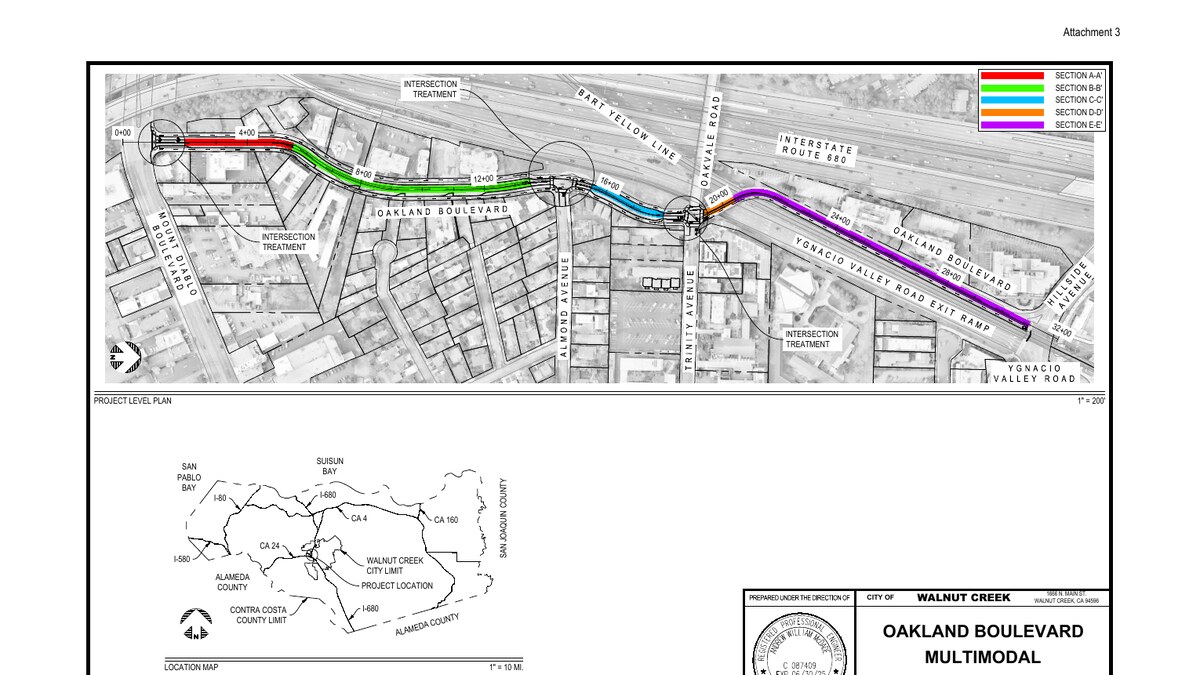
Oakland Boulevard is an important BART and downtown connection, but parts of it lack continuous sidewalks and comfortable bike facilities. This project adds Class IV bike lanes, sidewalks, a median island, accessible curb ramps, stormwater improvements, and streetscape upgrades.

The project is included in the adopted 2026 STIP, but the current estimate is that work would start in 2029.

This is one of those projects residents will feel immediately once it is built: fewer missing links, more predictable crossings, and a much better route between BART, downtown, and nearby neighborhoods.

Project-level aerial plan for Oakland Boulevard multimodal improvements between Mt. Diablo Boulevard and Ygnacio Valley Road.
Oakland Boulevard project-level plan. Source

Walnut Creek BART Access Improvements#

CCTA Phase 1 in design, construction ~2027; City-led Phase 2C seeking funding

Location
Walnut Creek BART station area, Ygnacio Valley Road, and N. California Boulevard

BART, CCTA, Walnut Creek, and partner agencies are working on several related station-access pieces around Walnut Creek BART. We are grouping them here because they all point toward the same goal: making the station easier and safer to reach without a car.

This is a three-agency effort, and each agency owns a different piece. BART owns the station property and the adjacent Transit Village housing development. The Contra Costa Transportation Authority (CCTA) leads the Shared Mobility Hub concept as part of its INNOVATE 680 program. The City of Walnut Creek leads the off-site street and intersection work on public right-of-way around the station.

CCTA's Shared Mobility Hub Phase 1 covers improvements on and immediately around BART property: a Class II bike lane on Riviera Avenue, e-bike charging, bike-access ramps on the station stairs, wayfinding signage, and a new bike connection and accessible plaza right at the Ygnacio Valley Road / California Boulevard intersection. CCTA's public timeline has design continuing through 2026, with construction targeted for summer or fall 2027.

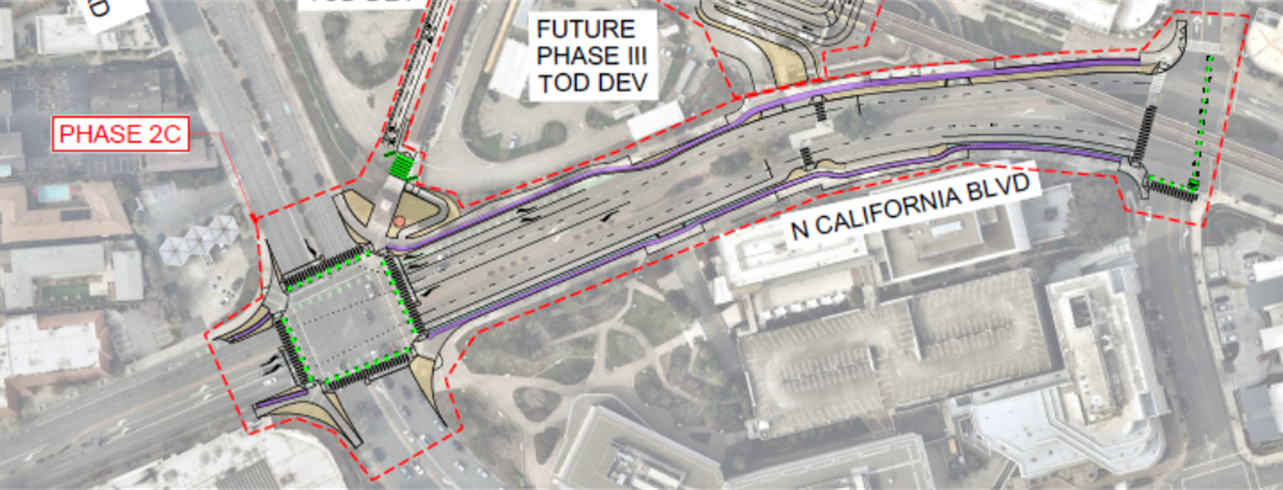
The City of Walnut Creek is separately leading the off-site corridor work on N. California Boulevard and Ygnacio Valley Road, broken into the City's own delivery phases. Phase 2C, the segment currently before CCTA for funding, would add Class IV protected bike lanes along N. California Boulevard plus safety and crosswalk improvements at the Ygnacio Valley Road intersection, continuing the low-stress bike connection from BART toward downtown. Ygnacio Valley Road and California Boulevard together account for roughly 30% of the traffic deaths and serious injuries in Walnut Creek, so this corridor carries real safety stakes beyond just station access. We do not yet have public documentation of what the City's earlier Phase 2A and 2B segments cover.

A related but separate project, BART's Walnut Creek Transit Village, is adding housing and retail next to the station in its own phases: Phase I (the Waymark) completed in 2023, Phase II is under construction, and a future Phase III is still to come. It shares the same site but is not part of the access-improvement funding described above.

Walnut Creek BART should be one of the easiest places in the city to reach by walking, biking, and transit. Better station access affects thousands of trips, not just the people who live immediately next to the station.

Read Walk Bike Walnut Creek's support letter

August 10, 2026

Tim Haile
Executive Director
Contra Costa Transportation Authority
2999 Oak Road, Suite 100
Walnut Creek, CA 94597

Subject: Letter of Support for Phase 2C Shared Mobility Hub Improvements

Dear Mr. Haile:

Walk Bike Walnut Creek strongly supports the City of Walnut Creek's application to fund Phase 2C of the Shared Mobility Hub improvements at N. California Boulevard and Ygnacio Valley Road.

Ygnacio Valley Road is one of Walnut Creek's most serious traffic safety challenges, accounting for approximately 30% of traffic deaths and serious injuries in the city. Together, Ygnacio Valley Road and California Boulevard also create a major barrier between Walnut Creek BART, Downtown Walnut Creek, and the surrounding neighborhoods.

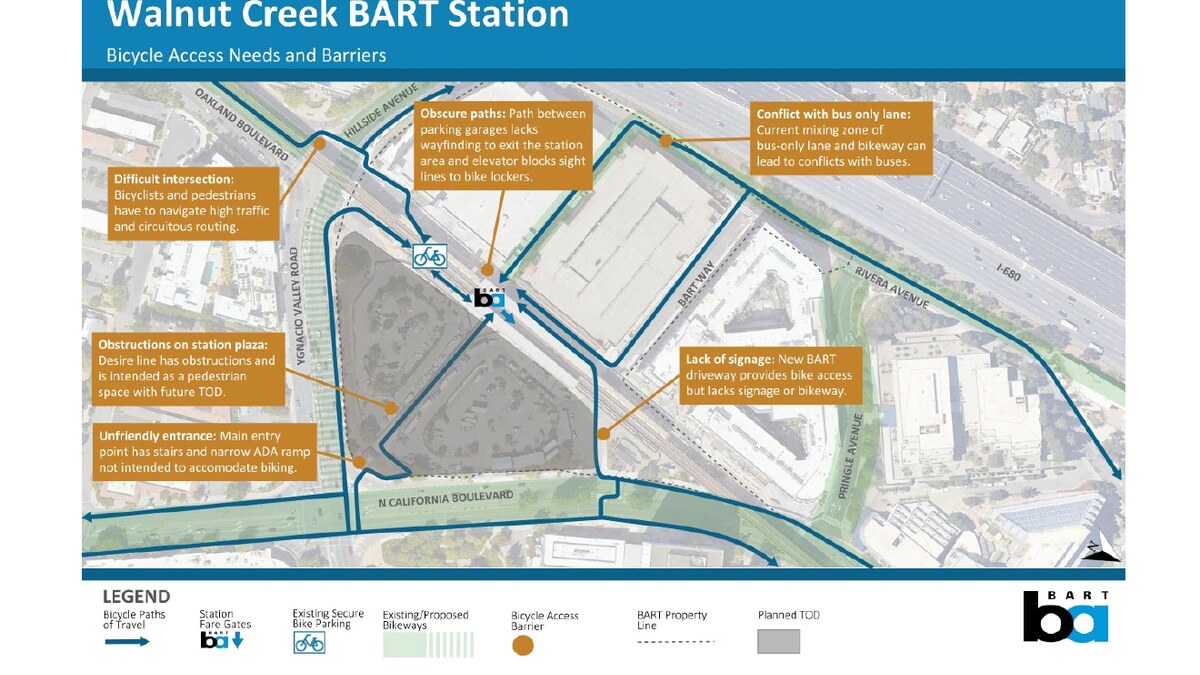
For people traveling by bicycle, reaching BART is currently a hazardous and high-stress experience. Riders are often forced onto narrow sidewalks immediately next to Ygnacio Valley Road, and even relatively direct trips require repeatedly crossing major arterials. A person approaching the station from Oakland Boulevard, for example, must make at least three separate crossings simply to reach BART.

The proposed intersection safety improvements and Class IV protected bicycle facilities on N. California Boulevard are an important step toward addressing these barriers. They will make access to BART safer and more comfortable, complement the other Shared Mobility Hub investments around the station, and help expand the number of trips that can realistically be made by bicycle and transit instead of by car.

We also see Phase 2C as an important step toward a continuous, low-stress bicycle connection between Walnut Creek BART, Downtown Walnut Creek, and the surrounding community.

Walk Bike Walnut Creek strongly supports this project and urges CCTA to fund the City's application.

Sincerely,

Toni Melisma and the rest of the board
Walk Bike Walnut Creek

Aerial project map showing the Phase 2C project boundary along N. California Boulevard and the Ygnacio Valley Road intersection, with a future Phase III TOD development area marked to the north.
City of Walnut Creek Phase 2C project area map, provided by City staff.
BART access needs and barriers map for the Walnut Creek BART station area near Ygnacio Valley Road.
Walnut Creek BART access needs and barriers map. Source

Walnut Creek Signage and Wayfinding#

City bike wayfinding update planned

Location
Citywide

The city has plans to update bike wayfinding around Walnut Creek. We are grateful the City is thinking about how people find and use the network, not just where lanes and paths exist.

Wayfinding signs help people understand where a route goes and how long it takes to reach places like BART, downtown, trails, parks, and schools. Better signs make the walking and biking network easier to use, especially for people who are not already confident riders.

Residents should not need insider knowledge to find a comfortable route. Clear signs can make existing investments work harder and help more people feel invited to walk or bike.

Future#

Proposed or early-stage projects that are in public project lists or planning discussions, but do not yet have a clear construction schedule.

Lincoln Avenue Bicycle Connector#

Proposed

Location
Lincoln Avenue from Iron Horse Trail to North Broadway, near Civic Park

The city has proposed a Class III bike connector on Lincoln Avenue between the Iron Horse Trail and North Broadway. We are grateful this short but useful connection is on the City's project list.

Lincoln Avenue could help people leave the Iron Horse Trail and reach Civic Park, downtown, North Broadway, and nearby destinations without relying on higher-stress streets.

This is the kind of low-cost connector that can make the larger network easier to understand and more useful for everyday riders.